India’s corporate banking market is shifting into a dynamic phase, as Indian companies look to buttress profit margins at home and grow their businesses internationally. The 689 CFOs and treasury professionals at large and middle market companies in India taking part in our most recent corporate and commercial banking studies rank reducing costs and increasing profitability as their top priority for the coming year.
Table of Contents

India’s corporate banking market is shifting into a dynamic phase, as Indian companies look to buttress profit margins at home and grow their businesses internationally, and foreign banks eye the country’s commercial banking/middle market segment as an increasingly attractive target. As the country’s private and public banks position themselves to compete in this new era, they should not allow the race to build out digital platforms and international networks (important as they are) to overshadow the one thing that corporates in India seem to prize most in their banking relationships: top-notch customer service.
The 689 CFOs and treasury professionals at large and middle market companies in India taking part in our most recent corporate and commercial banking studies rank reducing costs and increasing profitability as their top priorities for the coming year. As part of that effort, Indian companies have reduced their utilization of bank credit, preferring instead to draw on cash holdings supported by relatively healthy balance sheets. Despite that, the average number of banks employed by Indian companies for credit remained mostly unchanged, diverging from the trend of consolidation that is being seen in the broader Asia region.
While credit relationships remained flat, one area that stands out is cross-border banking. For the past several years, Crisil Coalition Greenwich has highlighted Indian companies’ increasing international ambitions. Data from our most recent studies shows those plans remain in place and may, in fact, be accelerating—especially with regard to specific international corridors. Over the past year, companies in India continued to increase the number of banks they employ for cross-border banking, even as domestic banking relationships remained flat.
Indian banks move beyond country borders
In the not-so-distant past, increasing demand for international banking services would have been a gift to the foreign banks that have traditionally dominated that business. That is not the case today. Over the past 12 months, India’s private banks have shown increasing cross-border usage for products such as cash management by companies in India.
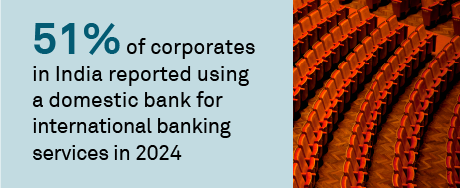
As shown in the following graphic, nearly half (46%) of corporates in India reported using a domestic private sector bank for international cash management services in 2023, with the biggest Indian private banks holding most of those relationships. In 2024, that share climbed to 51% with, again, most of those gains going to the country’s largest private banks. Over the same period, the share of Indian companies using a foreign bank for international cash management dropped from 40% to 36%.

At a much more modest level, India’s large private banks also gained ground and won relationships with companies in India in foreign exchange. These increases demonstrate that, as Indian companies look abroad for growth opportunities, the country’s private sector banks are eager and increasingly capable of serving their cross-border needs and competing on the international stage.
There is one area in which corporates in India still lean on foreign banks for support: trade finance. As cross-border trade and operations become a large part of Indian companies’ business strategies, trade finance is growing in importance and frequency of use. Foreign banks continue to be the beneficiaries. In 2023, only a quarter of Indian companies were using a foreign bank for trade finance. In 2024, that share jumped to 42%.
Over the same period, the share of companies using a domestic bank for trade finance dropped notably. The international network and trade-related know-how that the foreign banks bring to the table give them a distinct advantage in an era when companies in India increasingly utilize global supply chains. Indian banks still have work to do to establish themselves as viable competitors to foreign rivals in this space.
Indian corporates look to the Middle East
For companies in India looking to expand internationally, one of the biggest targets is the Middle East. As shown in the following graphic, from 2020 to 2024, the share of corporates in India requiring international banking services into the Middle East increased nine percentage points to 33%. That increase was consistent across companies headquartered in India and foreign corporates operating in the country.

Historically, foreign banks have been the go-to providers for such requirements. Foreign banks hold approximately three-quarters of these relationships, up from two-thirds in 2020. However, progress by India’s biggest private banks should not be overlooked. Since 2020, India’s large private banks have increased their share of relationships for international banking into the Middle East to 17% from 13%—a significant uptick for a group of competitors relatively new to the business and the region.
The silver bullet in the battle for corporate banking relationships: A good relationship manager
Foreign banks see India as an increasingly attractive market and an important source of potential growth. This perception could increase in the months and years ahead due to trade wars, fluctuations in tariff rates in the United States and other countries, and subsequent changes to trade flows and supply chains.
Already, many Japanese banks view India as a core pillar of their growth strategies, and several prominent Australian banks are making sizable investments in the Indian market. Meanwhile, global banks are increasingly targeting the massive middle market of Indian corporates, a segment that, until recently, was almost exclusively the territory of the country’s domestic banks.
As competition intensifies, banks from all regions will be in search of solid data that can help them win corporate banking relationships. The results of our 2024 Asian Corporate Banking Study—India provide some important—and in some cases surprising—insights into the factors that drive companies’ selection of banking partners.
The graphic below shows the top selection criteria used by Indian companies when choosing their banks. In both the large corporate and middle market segments, companies prioritize price and service over all other factors.

However, one factor—ease of doing business—surged in importance last year. That trend is not unique to India. Across Asia and around the world, corporates are citing ease of doing business as a critical factor in their assessment of current banks and selection of new providers. The increasing importance of this metric is often associated with complex regulatory and documentation requirements that can make the process of opening new bank accounts and even conducting day-to-day banking activities a headache for corporate treasury staff. Companies want banks that can alleviate these burdens and free up their treasury departments from these demands.
When Indian corporate treasury professionals are asked to define what ease of doing business means to them, many of their responses align with this view. For example, many participants in this year’s study cite operational excellence and digital capabilities as core elements of ease of doing business. Indeed, operational offerings such as simplified account opening and timely execution of day-to-day banking activities play a role in minimizing documentation and other “pain points” that have traditionally plagued corporate banking relationships, as do digital capabilities such as electronic signatures and automatic form population.

In a surprising twist, however, operational and digital capabilities that make life easier for treasury staff on a day-to-day basis do not rank at the top when it comes to defining the things that make up ease of doing business. To the contrary, 57% of study respondents associate ease of doing business with robust relationship management and advisory service. That includes understanding the company’s needs, coming to the table with a deep knowledge of the company’s business, industry and home country, and engaging with the company in a meaningful manner that provides real value.
These results should serve as an important lesson to both corporate treasury professionals and banks competing for their business: Although digital platforms and other capabilities are becoming ever more important in corporate banking relationships, these offerings are also widely available and increasingly commoditized. What is harder to find—and harder for banks to deliver—are good relationship managers who understand the business, take time to propose relevant solutions and add real value.

Corporate Banking Practice Leader (Asia & Middle East) Ruchirangad Agarwal and Pushpak Vanjari specialize in Asian corporate/transaction banking and treasury services.
From September 2024 to March 2025, Crisil Coalition Greenwich conducted interviews with 206 large corporates and, between December 2024 and March 2025, with 483 middle market businesses in India, focusing on key areas such as banking relationships, quality perceptions of the respective relationships and products used, including corporate lending, cash management, trade services and finance, foreign exchange, structured finance, interest-rate derivatives, and investment banking.
